
Monthly Market Note · November 2026
The cost you don’t see
Every money decision has a price you can see, and one you can’t.

Economists have a name for the price you can’t see: opportunity cost. It is what you give up by choosing one path over another. Spend $1,000 on one thing and the cost isn’t just the $1,000; it is also the best thing that money could otherwise have done.
Opportunity cost rarely shows up on a statement, but it can be the bigger number. This month, each part of our business looks at where it is hiding: in a rate rise, in an early super withdrawal, in the new capital gains tax rules and in a softer property market. Every figure is linked to its source at the end, and where we have done our own sums, we show the working.

Rate day · Melbourne Cup Day
What each rate rise costs you
The cash rate is the Reserve Bank’s target for the interest rate banks charge each other on overnight loans. It flows through to what lenders charge you on variable loans and what they pay you on savings.
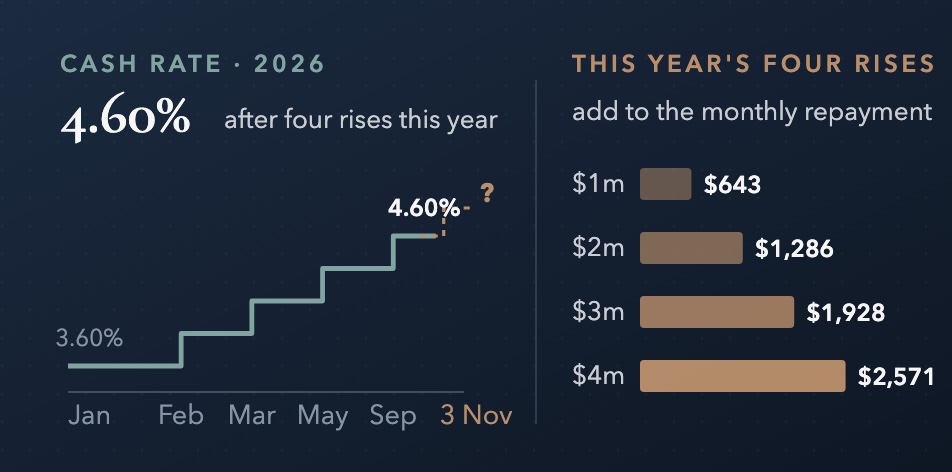
The Reserve Bank has lifted the cash rate four times in 2026, each time by 0.25 percentage points: in February, March, May and, most recently, on 29 September, taking it from 3.60% to 4.60%. Its concern is inflation, the pace at which prices rise. Inflation was 4.3% in the year to September, up from 4.0% in the year to August and well above the Reserve Bank’s 2–3% target. In September the Reserve Bank Board said a further tightening in financial conditions was warranted to bring inflation back to target. Its next decision is due today, Melbourne Cup Day, Tuesday 3 November.
The visible cost
To make this concrete, we worked out what a rise does to the monthly repayment on a new 30-year principal and interest loan, assuming the lender passes each rise on in full.
| Loan | One 0.25% rise | Per year | This year’s four rises | Per year |
|---|---|---|---|---|
| $1,000,000 | $165 /mth | $1,984 | $643 /mth | $7,713 |
| $2,000,000 | $331 /mth | $3,967 | $1,286 /mth | $15,427 |
| $3,000,000 | $496 /mth | $5,951 | $1,928 /mth | $23,140 |
| $4,000,000 | $661 /mth | $7,934 | $2,571 /mth | $30,854 |
Illustrative only. One rise: rate moving from 6.50% to 6.75%. Four rises: 5.50% to 6.50%. These are not any lender’s rates and your loan will differ. Affluens360 calculations.
The hidden cost
A simple rule of thumb falls out of the table: each 0.25% rise adds about $165 a month for every $1 million you owe. On a $3 million loan, this year’s four rises add close to $1,930 a month, or about $23,000 a year. That is the visible cost. The hidden one is what that money would otherwise have done. Sitting in an offset account (savings held against your loan, so you pay interest on a smaller balance), it would have been quietly reducing your interest. Going into super, it would have been compounding for retirement. Or it would simply have paid for something you had planned. Across a year of higher repayments, that adds up to a decision made for you.

One · Affluens360 Wealth Management
What $20,000 from super really costs
Super is meant to stay put until retirement, but it can be released early on what are called compassionate grounds: a short list of hardships set by the Tax Office. They cover things like medical treatment you can’t otherwise afford, palliative care, funeral expenses, modifying a home or car for a severe disability, and preventing the loss of your home to a mortgage or council rates debt.
In 2025–26 Australians withdrew about $1.46 billion from super this way, the vast majority for medical costs. Dental treatment was the largest single reason, at $892 million. The Tax Office says compassionate release should only be considered as a last resort.
Why the real cost is bigger than the bill
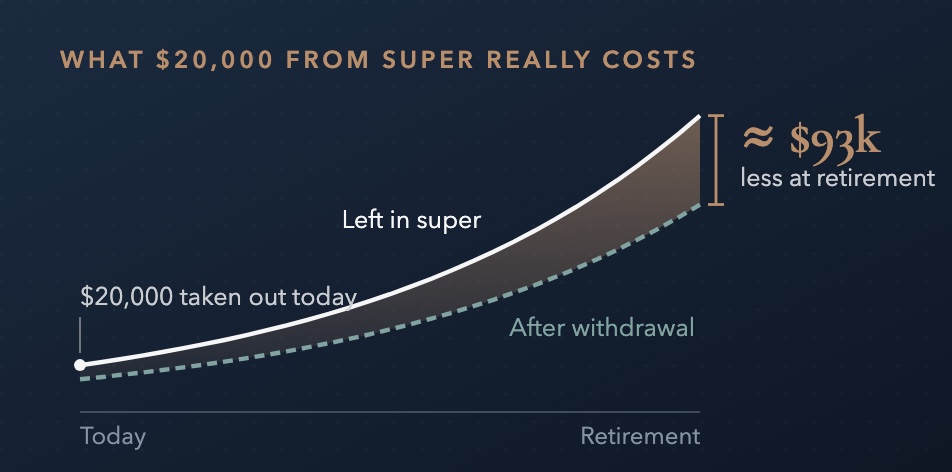
This is opportunity cost at its starkest. Money in super keeps compounding: it earns returns, and then earns returns on those returns, for decades. Money taken out stops. The Super Members Council estimates that $20,000 withdrawn today could cost about $93,000 by retirement.
The exact figure depends on your age, your fund’s returns and how long the money would have stayed invested. In general, the longer the money would have stayed invested, the wider the gap becomes.

Two · Affluens360 Tax & Business Advisory
One sale, two sets of rules
Capital gains tax (CGT) is the tax you pay on the profit when you sell an investment, such as shares or an investment property. New laws passed in June 2026 change how it is worked out for gains made from 1 July 2027. Here is the change in plain terms, based on what the Tax Office has published:
- Today: if you have held an investment for at least 12 months, you generally pay tax on only half the gain. This is the 50% CGT discount.
- From 1 July 2027: for individuals, trusts and partnerships, the discount is replaced. Instead, what you paid is increased in line with inflation (called indexation), and individuals pay at least 30% tax on certain gains.
- Your home: no change. The main residence exemption stays. Some other assets, including new residential dwellings and affordable housing, can stay on the current rules.
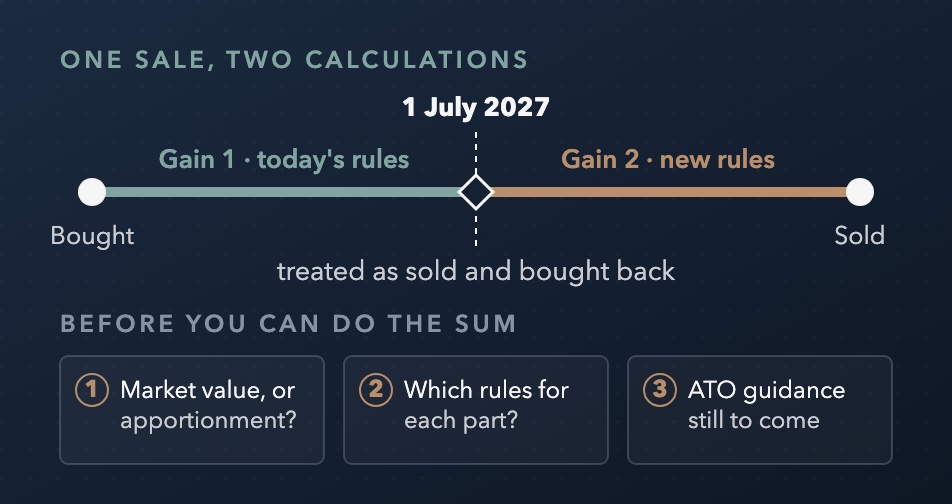
If you already own an investment and sell it after 1 July 2027, the law may treat it as if you sold it just before 1 July 2027 and bought it back that day. This happens on paper only. No tax is due until you actually sell.
Why this is harder than it looks
So when you sell, one sale may need two calculations: one for the gain up to 1 July 2027 under the old rules, with the 50% discount, and one for the gain after that date under the new rules, with indexation and the minimum tax. To split the gain between the two, you need a dividing line, and that is where it gets complicated. These are the questions behind a single sale:
- What was the investment worth on 1 July 2027? You may need its market value on that date, or a formula the Government is still developing that divides the gain between the two periods (called apportionment).
- Which method gives the right answer for this asset? That depends on when most of the growth happened, which isn’t known until later.
- Who owns it? The rules differ for individuals, trusts, partnerships, companies and super funds, and the minimum tax applies to individuals.
- Is it an exempt or special asset? New residential dwellings, affordable housing, assets bought before 20 September 1985 and your main residence each follow their own rules.
- What evidence will the Tax Office expect? It has said it will issue guidance on how to work out market value for certain assets, which professionals to consider for a valuation, and the records required.

Three · Affluens Property Group
A softer market changes the numbers
Home prices have eased in recent months. In its October Financial Stability Review, its regular check on risks to the financial system, the Reserve Bank linked the decline to weaker sentiment, interest rates and changes to negative gearing and CGT, and noted that downside risks to prices remain.
It also found that most household balance sheets remain strong. The median borrower (the one in the middle of the pack) holds more than a year of scheduled repayments in offset and redraw savings (extra repayments that can be drawn back out).
What a lower price is worth
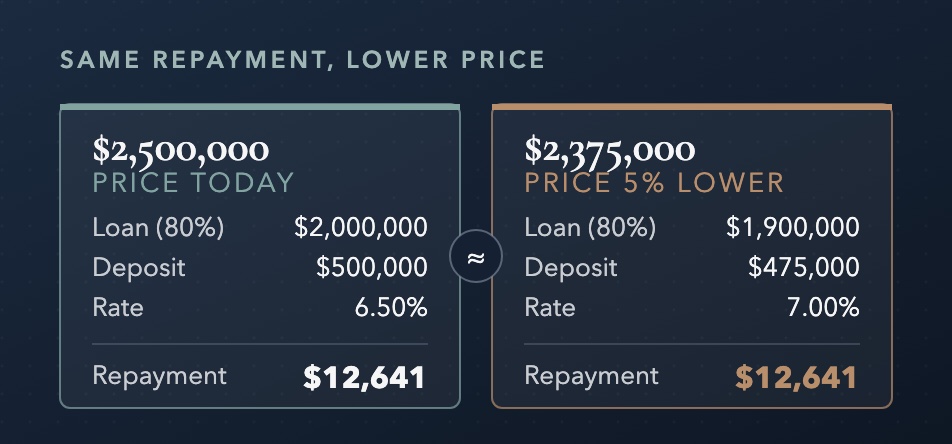
Rate rises get the headlines, but for a buyer the purchase price matters too, and it is set once, for the life of the loan. We compared what a lower price does to the repayment on the same home.
| Price | Loan (80%) | Repayment at 6.50% | Rate at which it matches $12,641 |
|---|---|---|---|
| $2,500,000 | $2,000,000 | $12,641 | 6.50% |
| $2,375,000 (−5%) | $1,900,000 | $12,009 | 7.00% |
| $2,250,000 (−10%) | $1,800,000 | $11,377 | about 7.54% |
Illustrative only. Monthly repayments on a 30-year principal and interest loan. The percentages work the same way at any price. Affluens360 calculations.
On these numbers, a 5% lower price means a $100,000 smaller loan and a $25,000 smaller deposit, and the repayment stays the same even if the rate is half a percentage point higher. A 10% lower price holds up to a rate about one percentage point higher. If rates rise beyond that, the advantage disappears, and borrowing capacity also falls as rates rise.
A quieter market can also mean fewer competing buyers and more room to negotiate. No one knows where “the bottom” is until it has passed, so the numbers that matter most are your own: your deposit, your buffer and how long you plan to hold.
Also this month · The Physician’s Portfolio, Episode 9
Heard about debt recycling over lunch?
Felix Taing and Abraham Aguilan on the part that usually gets skipped: whether borrowing to invest suits you at all, before the tax benefit. And why investing straight from your offset account isn’t debt recycling.
The visible cost is only half the picture.
If any of this touches your situation, book a time with us and we’ll work through what actually applies to you.

Warm regards,
The Affluens360 team
Sources
- Reserve Bank of Australia, Monetary Policy Decision, 29 September 2026, and Cash Rate Target
- Reserve Bank of Australia, Financial Stability Review, October 2026: Resilience of Australian Households and Businesses
- Australian Bureau of Statistics, Consumer Price Index, Australia, September 2026 (released 28 October 2026)
- Australian Taxation Office, CGT reform (13 October 2026) and CGT reform: guidance and market valuations (19 October 2026)
- ABC News, Australians withdrew a record $1.46 billion from super on compassionate grounds (23 October 2026), including the Super Members Council estimate and the Tax Office comment
- Repayment and breakeven figures: Affluens360 calculations, 30-year principal and interest, monthly repayments, illustrative rates
This communication has been prepared by Affluens360 Tax & Business Advisory Pty Ltd (ABN 64 605 929 986) for general information purposes only. It does not take into account your personal objectives, financial situation or individual needs. You should seek independent professional advice before acting on any information contained in this communication.
Any financial product advice contained in this communication is provided by Affluens360 Wealth Management Pty Ltd (ABN 46 152 465 462), a Corporate Authorised Representative (No. 410582) of Advisory Circle Pty Ltd (ABN 21 629 143 460, AFSL 513052). This advice is general in nature and does not consider your personal circumstances. You should consider whether it is appropriate for you before acting.
Any property-related commentary is provided by Affluens Property Group Pty Ltd (ABN 88 662 857 203) for general information purposes only. It does not constitute financial, legal or investment advice. Property values and borrowing capacity are subject to individual lender assessment and may vary. Affluens Property Group may receive fees for property advisory services. Affluens360 does not hold an Australian Credit Licence.
Past performance is not a reliable indicator of future performance. The information in this communication is based on our understanding of current legislation and regulations, which may be subject to change. Repayment figures are illustrative and are not any lender’s rate or an offer of finance. Market and tax commentary reflects publicly available information at 2 November 2026. Estimates and scenarios quoted are those of the organisations named, or our own illustrative calculations, are indicative only and are not a prediction of outcomes.
Tax commentary is provided by Affluens360 Tax & Business Advisory Pty Ltd, Tax Agent No. 26197318, is general in nature, is not tax advice and is not provided under AFSL 513052.